

Your puppy listened last week, but now recall has disappeared, leash pulling has returned, and familiar cues suddenly seem optional. Puppy training regression during adolescence is common, but it’s also a sign that it’s time to simplify training and reinforce good habits before unwanted behaviors become established.
Puppy training regression is a temporary drop in reliable behavior as a young dog matures, becomes more confident, and encounters stronger distractions. It commonly appears during adolescence. Owners can respond by reducing freedom, making exercises easier, rewarding correct choices, and practicing the same rules in several environments.
What puppy training regression looks like
Regression usually looks less like complete forgetting and more like unreliable performance. Your puppy may still sit in the kitchen but ignore the cue on a walk. Recall may work in the yard and fail when another dog appears. House manners can also slip when a growing dog receives more freedom than they are ready to handle.
Common signs
- Ignoring familiar cues around distractions
- Pulling, jumping, or rushing through doors again
- New difficulty settling calmly in the house
- Potty accidents after a period of success
- Recall that becomes slower or inconsistent
One difficult day is not necessarily regression. Look for a pattern across several days, then adjust the training plan instead of assuming your dog is stubborn. If a sudden behavior change comes with pain, appetite changes, unusual fatigue, or distress, contact your veterinarian. The UC Davis School of Veterinary Medicine provides additional canine health information.
Why does training slip during adolescence?
Adolescent dogs gain confidence and become more interested in the environment, so familiar cues must compete with stronger distractions. Training often slips when expectations rise faster than the dog’s skill, or when owners remove management before a behavior is dependable in different places.
A dog does not automatically understand that a cue practiced at home also applies at a busy East Bay park. Dogs learn in context, so reliability must be built gradually. Adolescence can expose gaps that were easy to miss when your younger puppy naturally stayed close and had less freedom.
Inconsistent follow-through can also weaken a cue. If one family member allows jumping or repeats “come” several times, the puppy learns that the first cue is optional. A shared household plan matters more than adding longer training sessions.
How to reset training without starting over
The good news is that regression rarely means your puppy has forgotten the training. More often, it means the environment has become more challenging than their current skill level. Instead of starting over, simplify the exercises and rebuild success one step at a time. The goal is a short streak of correct choices, not a long battle.
- Reduce distractions. Practice in a quiet room or yard where your dog can succeed.
- Shorten the exercise. Ask for a shorter stay, closer recall, or fewer loose-leash steps.
- Use worthwhile rewards. Choose food, toys, or access to an activity your dog values.
- Restore management. Use a leash, long line, crate, or supervised area to prevent rehearsal of unwanted behavior.
- Add difficulty gradually. Change distance, duration, or distraction, but not all three at once.
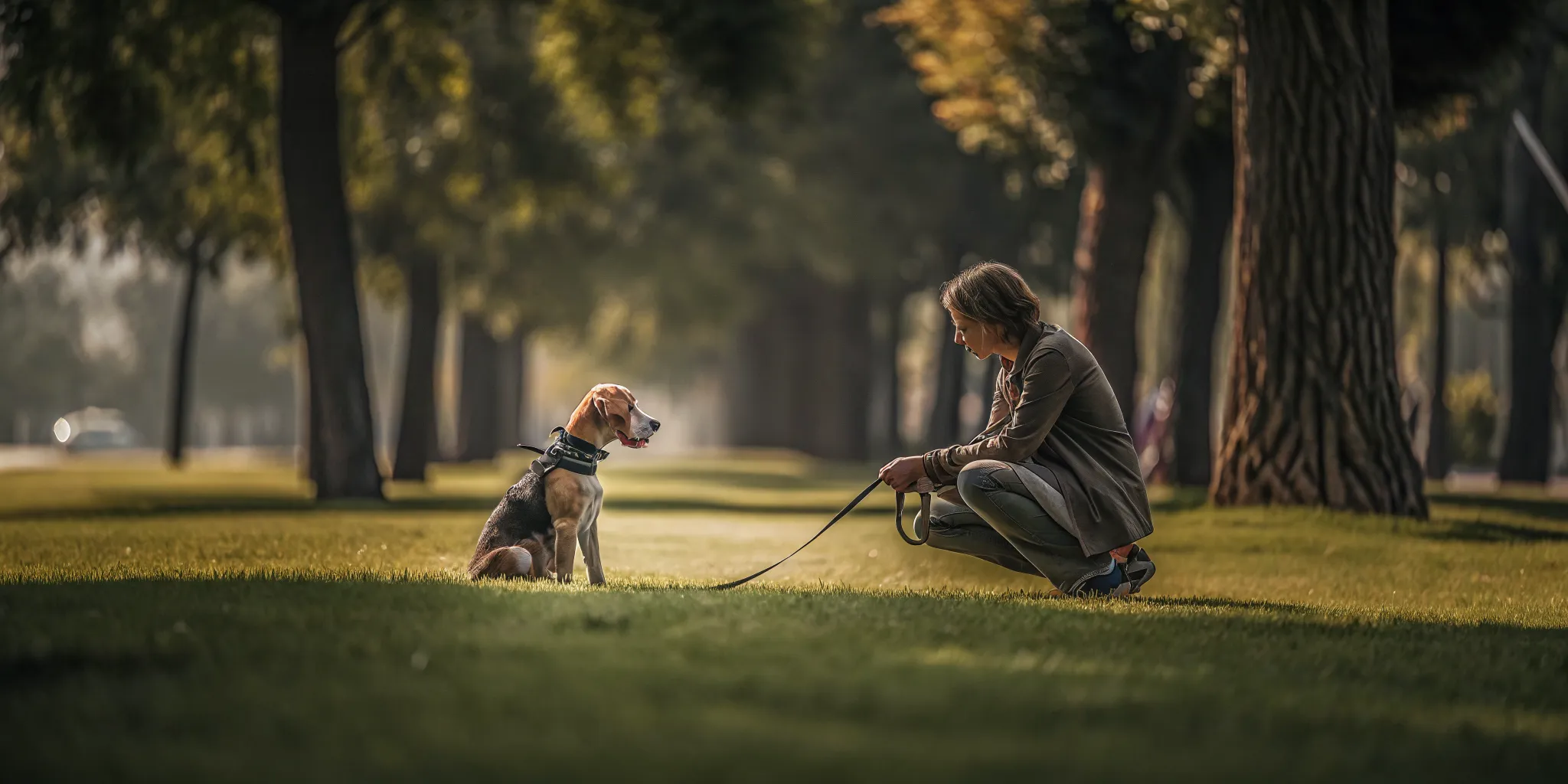
Keep sessions brief enough that both you and your puppy can stay focused. Three useful five-minute sessions usually beat one frustrating half-hour session. Our first 30 days of puppy training guide can help you rebuild a simple daily routine.
Quick fixes for common adolescent setbacks
Recall becomes unreliable
Stop testing recall in situations where failure is likely. Attach a long line, practice from a short distance, and reward quickly when your dog reaches you. Do not call repeatedly while your puppy keeps exploring. Build success in the yard before practicing near busier Northern California trails and parks.
Leash pulling or jumping returns
For pulling, reward a few steps beside you before your dog reaches the end of the leash. If the environment is too exciting, create more distance or choose a quieter route. For jumping, have everyone reward four paws on the floor and prevent guests from reinforcing the jump with attention.
House manners fall apart
Reduce unsupervised freedom and bring back a predictable schedule for potty breaks, rest, play, and training. Calm behavior is a skill, so reward your dog for settling on a bed or resting quietly near the family.
| Setback | Immediate adjustment | Sign to progress |
|---|---|---|
| Weak recall | Use a long line and reduce distance | Dog responds on the first cue |
| Leash pulling | Choose a quieter route and reward position | Dog checks in without prompting |
| Poor settling | Restore a rest schedule and supervised area | Dog relaxes without constant direction |
See how adolescent and adult board and train can help rebuild reliable real-world behavior.
When should you get professional help?
Get professional help when regression creates a safety risk, continues despite a consistent plan, or leaves you unsure how to make progress. Lunging, growling, biting, bolting, or severe distress should be addressed early rather than treated as a phase the dog will simply outgrow.
A trainer can identify where communication or management is breaking down and show every family member how to respond consistently. This is especially useful when your dog performs well at home but struggles in public. Medina Dogs Training works on behavior in real-home and real-world settings, then teaches owners how to maintain the results.
For younger dogs that need a stronger start, review the puppy behavior training guide. For adolescent dogs whose slipping behavior has become difficult to manage, professional adolescent dog training may be the practical next step.
Frequently asked questions
Is it normal for a puppy to regress in training?
Yes. Many puppies become less consistent as they enter adolescence and gain confidence. Treat the change as a signal to simplify exercises, restore management, and practice in more environments.
When does puppy training regression happen?
It often appears during adolescence, but timing varies by dog, breed, environment, and previous training. Focus on the behavior in front of you rather than waiting for a specific age.
Why is my puppy suddenly ignoring commands?
Your puppy may be distracted, confused, overexcited, or practicing in a setting that is harder than expected. Make the task easier and confirm that everyone uses the same cue and rule.
How long does puppy training regression last?
There is no fixed timeline. Consistent practice and management usually improve reliability, while repeated opportunities to ignore cues can extend the problem. Track progress weekly and seek help if you remain stuck.
Rebuild reliable behavior with a clear plan
Puppy training regression is frustrating, but it doesn’t mean you’ve failed. With consistent expectations and the right guidance, most adolescent dogs regain their reliability quickly. If you’re feeling stuck, we’re happy to help you create a plan that works for both you and your dog.
Call Medina Dogs Training at 510 576-5922 to schedule your free consultation.

Tim Medina is the founder and Training Director of Medina Dogs Training, specializing in real-world obedience and behavior modification for dogs of all ages and temperaments. With more than 14 years of hands-on dog training experience, Tim brings a rare combination of practical training expertise and executive-level leadership, delivering structured, results-driven programs designed for real-world reliability.
He helps dog owners solve serious behavior challenges including aggression, reactivity, leash pulling, and lack of recall through structured, results-driven board-and-train programs. Tim also serves as a Advanced Nose Work instructor at the Marin Humane Society, bringing institutional credibility and community trust to his work.
Tim works with clients in Fremont, Stockton, Sacramento, and surrounding Northern California areas, including the East Bay, Silicon Valley, and the greater San Jose region.

